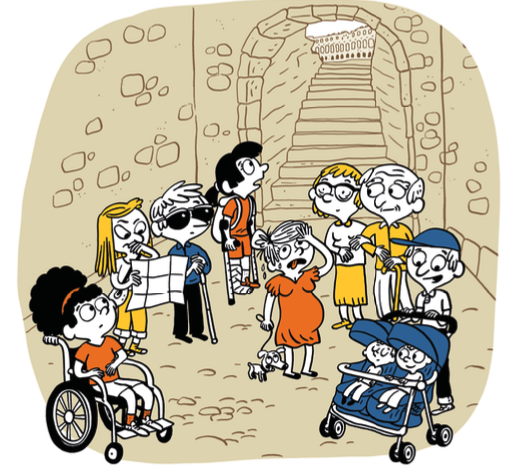
 © Loïc Méhée
"Guide to Improving the Accessibility of Archaeological Sites"
2025How would it be if as many people as possible could access archaeological sites in Switzerland?
Approximately 1.8 million people in Switzerland have a disability, and this figure is constantly rising due to an ageing population.
The 'Guide to Improving the Accessibility of Archaeological Sites' is divided into two parts: theory and arguments (part 1), and practical tools that can be applied directly (part 2).
This manual is for you if you want to find out more about:
- How to reach audiences with disabilities
- What the needs of visitors with disabilities might be
- What best practices exist in terms of accessibility in archaeology
- How to assess the accessibility of a specific site in just a few hours
- What concrete measures to take at an archaeological site
This guide can be adapted to your needs, allowing you to navigate freely between sections according to your questions and priorities at any given time.
It is the first guide in Switzerland to provide an overview of measures to improve accessibility at archaeological sites, and will help you on your way to achieving greater accessibility.
The French and German paper versions will be available from April 2026. The same applies to the digital German version.
In partnership with ArchaeoTourism and with the support of the Federal Office of Culture, the Federal Bureau for the Equality of People with Disabilities, and the Ernst Göhner, Däster Schild, Béatrice Ederer-Weber and Oertli foundations.
Web version in FrenchPrintable version in FrenchOrder the printed publication FROrder the printed publication DERelated content
- Archaeological sites and parks for all
- Publication “Ensuring Access to Archaeological Sites: Reflections and Examples of Good Practice”
- Universal Access
- Archaeology
- Switzerland
- Management
- Publication
- Participatory approach
- Interdisciplinarity
- Multilingual